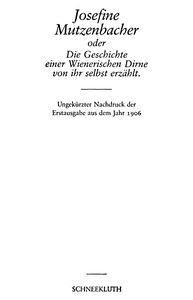
Josefine Mutzenbacher by Felix Salten
Let's get the obvious out of the way first: this book is famously explicit. Written by Felix Salten (yes, the guy who wrote Bambi), it was published anonymously in 1906 and caused an immediate scandal. It's presented as the fictional memoir of Josefine Mutzenbacher, an older woman now living in comfort, as she tells her life story to an unnamed writer.
The Story
Josefine grows up in extreme poverty in Vienna. From a very young age, her world is one where sex is a transaction, a tool, and sometimes a threat. She narrates her experiences with a detached, almost businesslike tone, describing her journey from a child in a crowded tenement to a sought-after courtesan. There's no traditional plot with a clear beginning, middle, and end. Instead, it's a series of episodes—some shocking, some sad, a few darkly funny—that chart her survival strategy. She learns to navigate a society where men hold all the power and economic cards, and she becomes an expert at turning their desires to her advantage. The story ends with her reflecting on her past from a position of hard-won security.
Why You Should Read It
If you can look past the surface, this book is a fierce social critique. Salten isn't just writing to shock. He's holding up a mirror to the hypocrisy of his time. The men Josefine encounters—from all classes—are often grotesque, entitled, or pathetic. Her blunt narration strips away all romantic pretense, exposing the ugly economic realities beneath relationships. What got me was Josefine's voice. She's not asking for pity. She's stating facts. This makes her a fascinating and challenging narrator. You're constantly wrestling with her perspective. Is she resilient or broken? Cynical or clear-eyed? The book doesn't give easy answers, and that's its strength.
Final Verdict
This is not a book for everyone. It's graphic and deeply unsettling. But if you're interested in literary history, unflinching social realism, or complex female characters who defy simple labels, it's a must-read. Think of it as the dark, radical cousin to more polite novels about fallen women. Perfect for readers who don't mind being made uncomfortable by a book, and for anyone who wants to understand a darker side of Viennese society that history often glosses over. Approach it with an open but critical mind.
This is a copyright-free edition. Enjoy reading and sharing without restrictions.